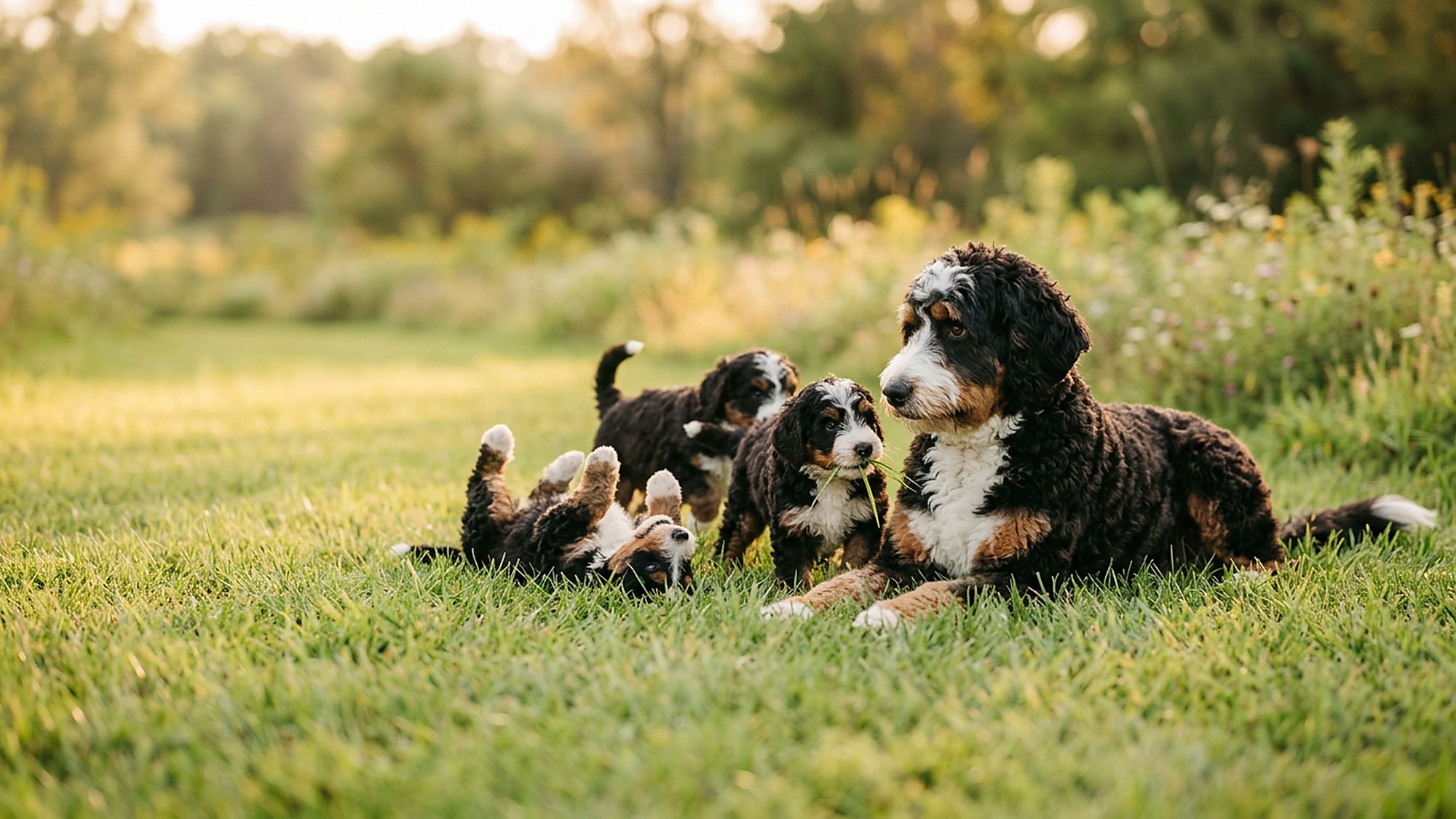
What a Bernedoodle actually is
A Bernedoodle is a cross between a Bernese Mountain Dog and a Poodle, bred for the Bernese temperament with a coat that sheds far less.
A Bernedoodle is a cross between a Bernese Mountain Dog and a Poodle. The point of the cross is not novelty. The Bernese is one of the gentlest large breeds ever put to work, and it comes with two hard problems: it sheds heavily and it does not live very long. Crossing to a Poodle keeps most of the temperament, drops most of the shedding, and widens the gene pool enough that the average lifespan moves in the right direction.
What you get is a dog that is generally soft-natured, people-obsessed, slower to mature than a retriever, and more sensitive to how it is handled. That sensitivity is the part most buyers underestimate. A Bernedoodle raised in a chaotic first eight weeks tends to stay reactive. One raised on a real socialisation protocol tends to stay steady. The breeder matters more with this cross than with a harder-wired working breed.
F1, F1b and F2b — which generation to actually buy
F1 Bernedoodles are half Bernese and half Poodle with variable coats; F1b Bernedoodles are backcrossed to a Poodle and are the most reliably low-shedding choice for allergy households.
Generation labels describe how much Poodle is in the cross, and the only reason to care is coat behaviour. Everything else is marketing.
If nobody in the house reacts to dogs, an F1 is a fine dog and often has the most classic Bernese look. If somebody in the house reacts to dogs, do not gamble on an F1. Take the F1b or the F2b and accept the extra brushing that comes with it.
- F1 — 50% Bernese, 50% Poodle. Coats vary litter to litter and even puppy to puppy. Some are wavy and low-shedding, some shed noticeably. Best markings, least predictable coat.
- F1b — an F1 bred back to a Poodle, so roughly 75% Poodle. The most reliably low-shedding option and the one to pick if allergies are a real concern. Curlier coat, more grooming.
- F2b — a later-generation cross with a similar coat outcome to F1b and slightly more variety in appearance.
- No Bernedoodle is hypoallergenic. Low-shedding is not the same as allergen-free — dander and saliva proteins are what people usually react to, not hair.
Standard, mini and tiny — what the sizes really mean
Standard Bernedoodles typically mature between 70 and 90 pounds, mini Bernedoodles between 25 and 49 pounds, and tiny Bernedoodles under about 25 pounds.
Size is set by which Poodle was used. A Standard Poodle gives you a standard Bernedoodle, a Miniature Poodle gives you a mini, a Toy Poodle gives you a tiny. Predicted adult weight from a reputable breeder is a range, not a number, and it should be given to you honestly before you pay a deposit.
Alberta households usually overestimate how much dog they want and underestimate what that dog costs to feed, board, medicate and groom. An eighty-pound doodle is roughly double a forty-pound doodle on every recurring line item, and it is a different animal in a condo, in a small vehicle, and on winter ice with an unsteady owner. Pick the size that fits the smallest room you live in and the oldest person in the house, not the size that photographs well.
Shedding, allergies and what the coat costs you
Bernedoodles shed very little, but the low-shedding coat traps hair instead of dropping it, so it needs brushing several times a week and professional grooming roughly every six to eight weeks.
The trade is simple: the hair that does not land on your floor stays in the coat. Left alone it mats, and a matted doodle is not a grooming problem, it is a welfare problem. Mats pull on skin, hide hot spots, and end in a shave-down that costs more and looks worse than maintenance would have.
Budget realistically. Professional grooming in the Edmonton region runs meaningfully per visit for a standard-size doodle, six to eight times a year, plus brushing at home several times a week. Start the brushing on day one when there is nothing to brush, so the dog learns to stand for it before it matters.
Alberta adds its own wrinkle. Wet snow balls up in a long coat and freezes into ice knots behind the legs and between the pads, and road salt sits in the fur and irritates skin. Winter coats stay shorter here for a reason.
Temperament, and the part people get wrong
Bernedoodles are affectionate, biddable and slow to mature. Expect a large puppy brain in a large body until somewhere past eighteen months. They are not aloof dogs; they want to be in the room. Left alone ten hours a day, a Bernedoodle does not cope quietly, it develops separation problems.
The other thing people get wrong is intelligence. Poodle intelligence is not obedience, it is problem-solving. An under-stimulated Bernedoodle will find its own job, and the job it picks is rarely one you would have assigned. Ten minutes of structured thinking work does more for household peace than an hour of fetch.
What a Bernedoodle costs in Alberta
A well-bred Bernedoodle puppy in Alberta generally runs from about $2,500 to $4,500, and our price is $3,000 all-in with nothing added later.
Prices across the province vary more than they should, and the number by itself tells you very little. What matters is what the number includes. Ask any breeder to itemise it. A price that arrives without a list attached is a price that grows later.
Then budget for the dog, not the purchase. First-year costs beyond the puppy price — vet visits, spay or neuter, food, crate, grooming, insurance, training — comfortably reach four figures for a standard-size doodle in this region. The purchase price is the smallest cheque you will write over fifteen years.
- Included with us: first round of shots, full deworming, vet health exam, a written health record and a 1-year health guarantee — plus a go-home bag with their food, a scent blanket, a collar and matching leash, a favourite toy and a Kong. Nothing to buy on day one, and lifetime breeder support after.
- Watch for: separate charges for first shots, a health certificate, or a training package that was implied to be included.
- A deposit should hold a place in a litter, not a specific puppy chosen off a photo at three weeks old.
- A price far below the range is a warning, not a bargain. Health testing is the largest cost a breeder can quietly skip.
Health testing: the questions that separate breeders from flippers
A responsible Bernedoodle breeder can produce OFA or PennHIP hip and elbow results, an eye clearance, a cardiac clearance, and a genetic panel for both parents, on paper, on request.
"Vet checked" is not health testing. A vet check is a physical exam. Health testing is orthopaedic imaging, an ophthalmologist exam, a cardiac evaluation and a DNA panel, all with certificate numbers you can look up yourself. The Bernese side carries real risk for hip and elbow dysplasia and for cancer; the Poodle side carries progressive retinal atrophy, von Willebrand disease and degenerative myelopathy among others.
Ask for the documents before the deposit, not after. A breeder who has done the work sends them without hesitation, because paying for it was the hard part and showing it is the easy part. Hesitation, deflection, or an offer to show you "at pickup" is your answer.
- Hips and elbows — OFA or PennHIP, both parents, with numbers.
- Eyes — an ophthalmologist exam, not a general vet glance.
- Heart — a cardiac clearance on both parents.
- DNA — a breed-relevant genetic panel covering PRA, vWD and DM at minimum.
- A written health guarantee, with the terms stated plainly rather than described over the phone.
How to spot a bad Alberta breeder in one conversation
Most bad outcomes are visible before money changes hands. The pattern is consistent: pressure, vagueness, and a refusal to let you see anything real.
The single most useful question is the least confrontational one. Ask to see the mother, live, on video, in the room where the puppies are. A broker who does not own the dam cannot do it, and will explain at length why not.
- Multiple breeds or constant litters available. Real programs run a few litters a year and have waiting lists.
- No video or in-person access to the mother in the whelping space.
- Payment by e-transfer only, with urgency, and a puppy that must be claimed today.
- Puppies offered to leave before eight weeks. Under eight weeks is both a developmental problem and, in most of Canada, not acceptable practice.
- Health testing described rather than documented.
- No contract, no health guarantee, and no take-back clause. A breeder who will not take the dog back at any point in its life is not standing behind it.
- Stock photography, or photos that keep changing background.
Ten questions to ask before you send a deposit
Send these in writing. How a breeder answers a written list tells you more than a friendly phone call does.
- Can I see hip, elbow, eye, cardiac and DNA results for both parents?
- Can I meet the mother, in person or on live video, in the whelping room?
- What is your socialisation protocol between three and eight weeks?
- What exactly is included in the price, and what will I be charged for later?
- What does the health guarantee cover, for how long, and what does it require of me?
- Do you take a dog back at any age if my situation changes?
- How do you match puppies to families, and who makes the final call?
- What is the predicted adult weight range for this litter, and what is it based on?
- What does the coat need in year one, and what will grooming cost here?
- Who do I call at 11pm in week three when something goes wrong?
Bringing a puppy home in Alberta
The province adds a handful of practical constraints that matter more than people expect. Winter puppies need indoor housetraining strategy, because a twelve-week-old will not hold it standing on frozen concrete at minus thirty. Summer puppies need shade discipline, because a black-and-tan double-influenced coat absorbs heat fast.
Grass awns, foxtails and burrs in late summer bury themselves in a curly coat and migrate into skin. Rural properties near the counties are worth checking the dog over after every long walk. Coyotes are a genuine consideration on acreages west and south of Edmonton, and a puppy is small enough to be prey. None of this is a reason not to have a dog here. It is a reason to plan the first year rather than improvise it.
Municipal licensing applies almost everywhere in the region — Edmonton, Strathcona County, Parkland County, Leduc County and the towns inside them all license dogs. Budget for the licence in your first week home — it is a five-minute job online in most municipalities.
How our program works
Bernedoodles & Co. is a small home-based Alberta program running a few litters a year, with every family matched to a puppy through the free Family Fit Blueprint rather than choosing from photos.
We keep two dogs and run a few litters a year. That is the whole program, and it is deliberate. Puppies are raised inside the house, on the floor, through the noise of an ordinary household — vacuum, doorbell, kids, cast iron dropped on a stovetop — because that is what they are going home to.
We do not sell puppies from photographs. Every family starts with the Family Fit Blueprint, a six-minute questionnaire about your household, your hours, your space and your tolerance for grooming and noise. It produces a written read on what actually suits you, and it is free whether or not you ever buy a dog from us. Sometimes the honest answer is that this is the wrong breed for your life, and it is cheaper for everybody to find that out now.
Not sure a Bernedoodle fits your house?
The Family Fit Blueprint takes six minutes and gives you a straight read on size, coat and energy against your actual household. It is free, and it costs you nothing if the answer turns out to be no.
Find my fit — freeFrequently asked questions
How much is a Bernedoodle puppy in Alberta?+
Well-bred Bernedoodle puppies in Alberta generally run from about $2,500 to $4,500 depending on generation, size and what the breeder includes. Ours are $3,000 all-in — vaccinations, deworming, vet exam, starter kit and lifetime support, with nothing added later.
Do Bernedoodles shed?+
Very little compared to a Bernese Mountain Dog, but the amount depends on generation. F1b Bernedoodles are the most reliably low-shedding. No Bernedoodle is hypoallergenic — people react to dander and saliva proteins, not hair — so anyone with a serious allergy should spend time around an adult of the same generation before committing.
How big do Bernedoodles get?+
Standards usually mature between 70 and 90 pounds, minis between 25 and 49 pounds, and tinies under about 25 pounds. Adult size is driven by which Poodle was used, and any honest prediction comes as a range rather than a single number.
What is the difference between an F1 and an F1b Bernedoodle?+
An F1 is a first cross — half Bernese, half Poodle — with a coat that varies from puppy to puppy. An F1b is that cross bred back to a Poodle, roughly 75% Poodle, which makes the low-shedding coat far more predictable. Choose F1b if allergies are a real factor in the household.
How long do Bernedoodles live?+
Typically 12 to 15 years for minis and around 10 to 13 for standards, which is longer than the Bernese Mountain Dog average. Hybrid vigour helps, but health testing on both parents is what actually moves the number.
Are Bernedoodles good with kids?+
Generally yes. The Bernese temperament is soft and tolerant, and most Bernedoodles are patient with children. The practical caution is size and clumsiness rather than temperament — a seventy-pound adolescent that has not learned to settle can knock a toddler over without meaning any harm.
How much grooming does a Bernedoodle need?+
Brushing several times a week at home and a professional groom roughly every six to eight weeks. The low-shedding coat holds the hair it drops, so skipping maintenance ends in matting rather than in a tidy dog.
How do I find a reputable Bernedoodle breeder near Edmonton?+
Ask for hip, elbow, eye, cardiac and DNA results for both parents, ask to see the mother live in the whelping room, and ask what happens if you cannot keep the dog in five years. A breeder who answers all three plainly and in writing is almost certainly worth talking to. One who deflects on any of them is not.
How long is the wait for a Bernedoodle puppy in Alberta?+
From a small program, expect months rather than weeks. We run a few litters a year, so families typically wait one to two litters from the time they complete the Family Fit Blueprint. Anyone with puppies constantly available is running a volume operation.
Do you deliver puppies outside Edmonton?+
We serve Edmonton, Strathcona County, Parkland County and Leduc County, and families collect their puppy in person so we can walk through the first week face to face. We do not ship puppies as air cargo.
Areas we serve
We place puppies with families across the Edmonton region. Each page below covers what owning a Bernedoodle is actually like in that community — grooming, bylaws, winter, and where to walk a puppy.